Hi Vis Workwear: What is ANSI?
Unless you are a seasoned safety manager, it's likely that you aren't aware that there are different levels and standards of hi-vis gear. These standards are designed to keep workers safe in a variety of work environments and job roles. Whether you are an employee or manager shopping for safety apparel for your employees, you'll see a lot of discussions related to ANSI 107 standards.
ANSI is The American National Standard for High-Visibility Safety Apparel and Accessories (ANSI/ISEA 107-2015) is a standard established by American National Standards Institute, Inc. Safety apparel must be labeled with ANSI/ISEA 107-2015 to be in compliance with the 2009 Manual on Uniform Traffic Control Devices (MUTCD).
The standard continues to present three performance classes of garments based on the amount of visible materials and design attributes incorporated into the final configuration, and identifies garment types based on expected use settings and work activities being performed. These are designated as off-road (type O), roadway and temporary traffic control (type R), or public safety activities (type P).
To comply with ANSI/ISEA 107-2015, a garment’s background material, and retroreflective or combined-performance material, must be tested by an accredited laboratory. The manufacturer of the finished item then verifies that the garment or headwear meets all the requirements of the standard, and provides a Declaration of Conformity for each model.
ANSI/ISEA 107-2015 focuses on the following:
- Design & Fit
- Requirement for Background and Combined-Performance Retroreflective Materials
- Photometric and Physical Performance Requirements for Retroreflective Materials
- Labeling Requirements
To comply with ANSI/ISEA 107-2015, a garment’s background material, and retroreflective or combined-performance material, must be tested by an accredited laboratory.
ANSI Safety Apparel Design & Colors
The ANSI/ISEA 107-2015 standard provides design guidelines and specifies the photometric requirements, minimum amounts of component materials, colors, and placement to create garments and headwear for the purpose of enhancing the visibility of workers. Section 6 of the standard offers detailed information. The selection of components and classes of apparel should be made based upon what is appropriate for the hazard, keeping the safety of the worker in mind as the upmost priority.
There are three different colors for background and combined-performance material available: fluorescent yellow-green, fluorescent orange-red and fluorescent red. Determining the best color combination depends largely on the work and natural environment, lighting and whether the garment is work during the day or night. Color selection for the workwear should be in contrast to the surrounding or equipment in use.
What are the ANSI Garment Types and Classes?
There are three type designations for high visibility safety apparel within the ANSI/ISEA 107-2015 standard. These types apply to the type of worker and environment the safety gear is to be used in. The types are further broken down into classes 1, 2 and 3.
Type "O" garments are for workers who are not required by MUTCD 2009 to wear high visibility safety apparel, but still work with moving equipment, vehicles or accompanying struck-by hazards where visibility is a concern.
Type "R" garments are for workers who are exposed to roadway traffic and work with moving equipment, vehicles or accompanying struck-by hazards where visibility is a concern. This type of designation and the classes within make up the PPE that is federally mandated per the MUTCD 2009.
Type "P" garments are derived from the previous ANSI 207 standard. This type designation allows options for fire, police, and EMS personnel who have other potential hazards that require them to access equipment on their person.
What is the Difference Between ANSI Class 1, 2 and 3?
Class 1
Designed for low-impact work areas. According to OSHA, this includes areas where traffic flow does not exceed 25 mph. Class 1 gear is typically used for parking attendants, delivery drivers, and roadside assistance personnel in low traffic areas.
Class 1 gear should have a minimum of 155 square inches of reflective tape. Dimensions of the reflective tape can be either 6.46 linear feet of 2-inch tape or 9.30 linear feet of 1 3/8-inch tape. The reflective stripes should be around the middle in a 360-degree stripe and above each shoulder.
Class 2
Designed for those working near heavier traffic and in low visibility areas. In these areas the flow of traffic may is between 25 and 50 mph or areas where weather may reduce visibility. Class 2 gear is typically used for airport workers, high-volume parking or toll booth operators, forest workers, and warehouse or mill workers.
Class 2 gear must have a minimum of 201 square inches of reflective tape. Dimension of the reflective tape can be 8.373 linear feet of 2-inch tape or 12.2 linear feet of 1 3/8-inch tape. The reflective stripes should be over the shoulders and around the middle in either on or two 360-degree horizonal stripes.
Class 3
Designed for high-traffic areas including site inspectors, emergency responders, railway workers, and utility crews. Traffic in these areas may be close to or exceed 50 mph. Workers typically work right next to the road or in other hazardous areas.
Class 3 gear must have a minimum of 310 square inches of reflective tape that is 12.92 linear feet and 2-inches wide. This includes a requirement that the worker have a full silhouette outline.
Requirements for Background and Combined-Performance Materials
Section 8 of the standard provides specifications for color, brightness, fabric strength, and moisture resistance after various exposure tests.
Background and Combined-Performance materials need to be tested for chromaticity/color and luminance without preconditioning. Table 3 in Section 8 is the requirement for both background and combined-performance materials.
Photometric and Physical Performance Requirements for Retroreflective Materials
Initial photometric performance is defined in Table 5 with a combination of 4 entrance, 4 observation and 2 oritation goals.
All materials must meet the minimum brightness requirements after tests for abrasion resistance, flexing, folding at cold temperatures, variation in temperatures, influence of rainfall, and laundering.
Labeling Requirements
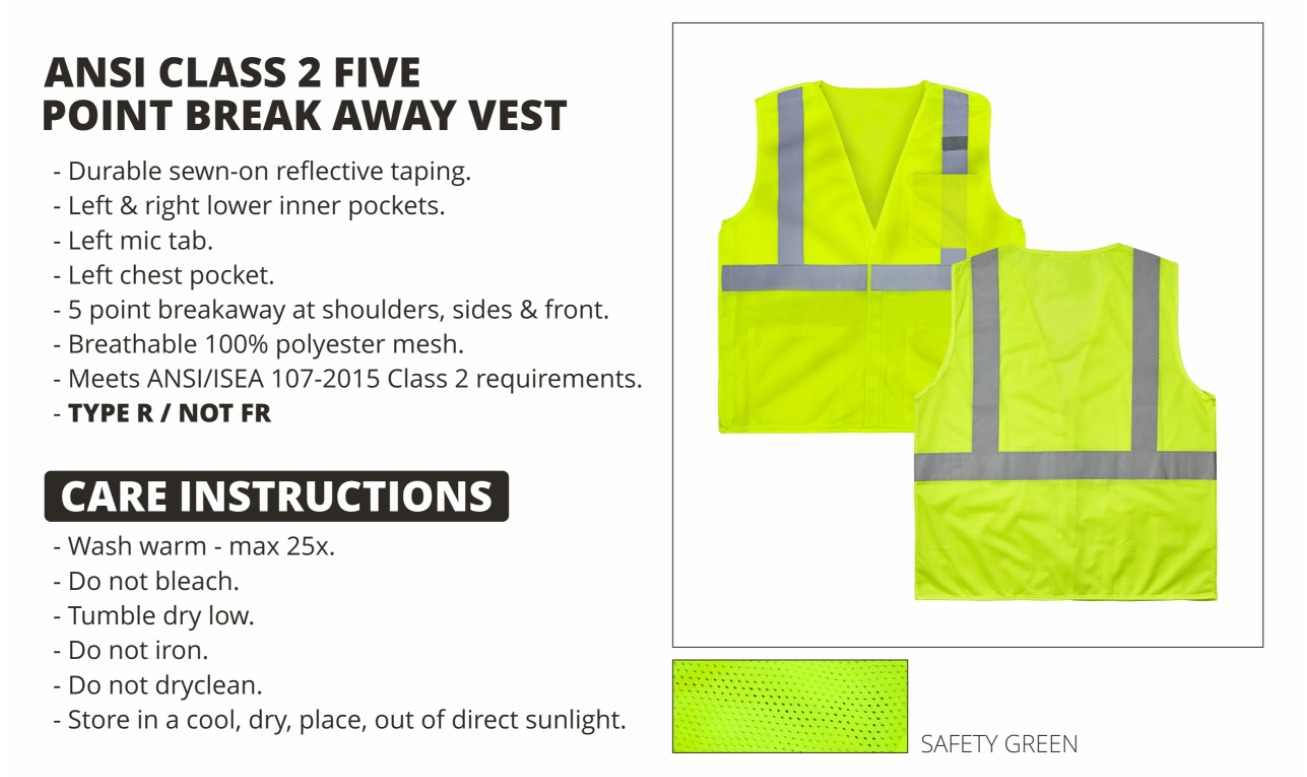
Marking includes at minimum:
- Manufacturer's name or other means of identification
- Item number or specific style of product
- Size
- The ANSI/ISEA standard name including year ie. ANSI/ISEA 107-2015
- Compliance with the flame resistance
- Maximum number of washes ie. max 25x
Visit www.safetyequipment.org for a complete copy of the ANSI/ISEA 107-2015 Standard.
BLU Marketing Concepts is a distributor of branded hi-vis apparel that meets ANSI/ISEA 107-2015 requirements. To view a selection of our hi-vis apparel visit: BLU Marketing Concepts - Hi-Vis Gear